Saturday, October 25, 2014

Warm Dry Autumn Days Might Equal Stressed Plants


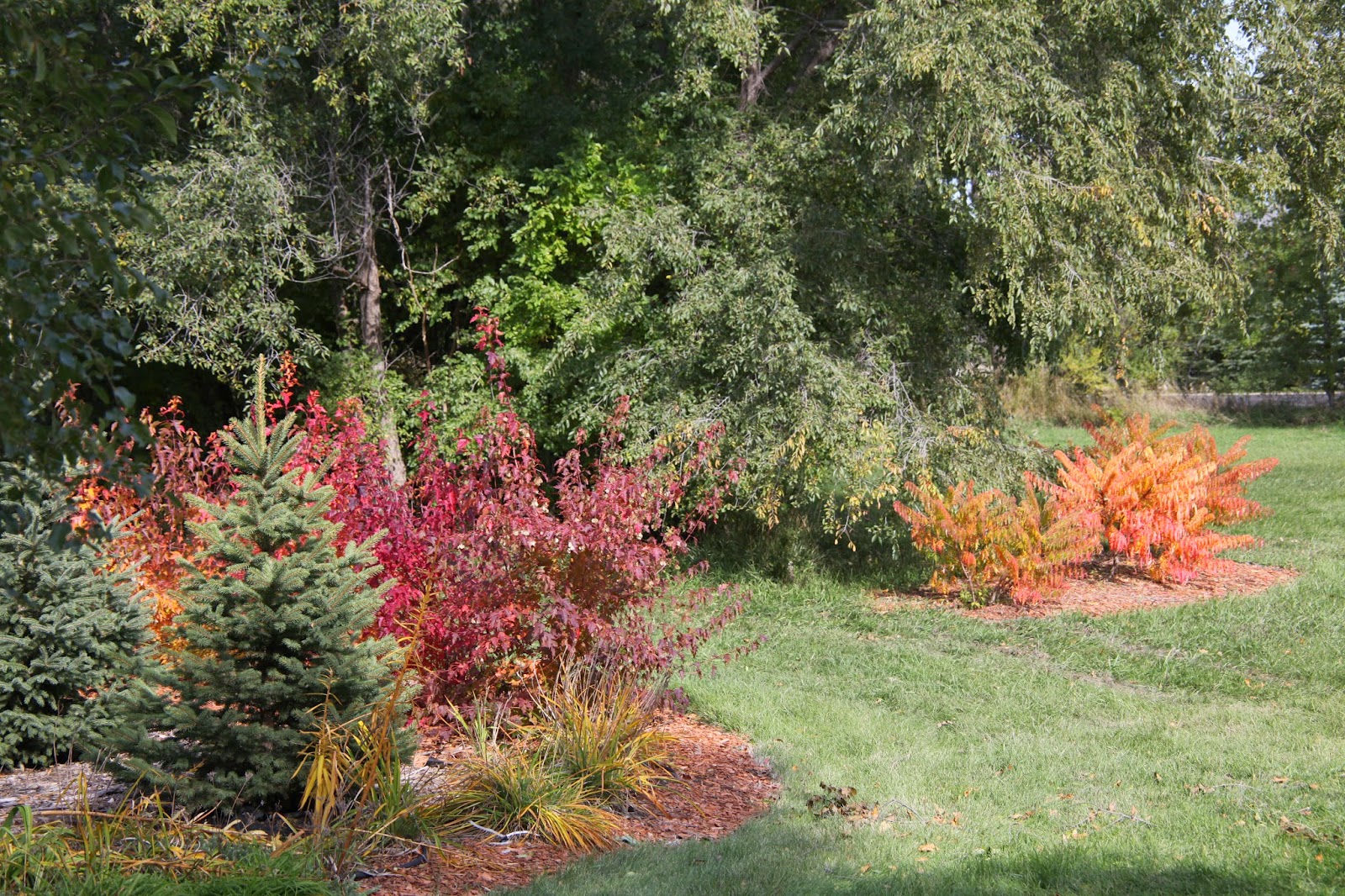
Autumn at Wiese Acres

Last year, we had our first snow storm on October 4.  This year, it is October 25 and we are outside in our short sleeves.  High temperatures during the day have been in the 70's and even up into the 80's.  That's good for us.  Unfortunately, it can be pretty stressful for the trees, shrubs, and perennials, especially when those warm temperatures are accompanied by low humidity and no rain.

Any non-dormant plants, especially trees and shrubs, should be kept well watered going into winter.  Usually, cooler October temperatures mean that if you gave them a good soaking, either with rain or irrigation in mid to late September, they will be ok for the winter.  Not this year, though.  They will need additional water until they are fully dormant, or air and soil temperatures are below 40 degrees.  Watering should be done early enough in the day so that it has time to soak in thoroughly before temperatures drop below freezing at night.

Newly planted trees are most susceptible to winter drought injury. Trees can take several years of growth to establish a good, deep root system.  The larger the tree when it is transplanted, generally the longer it takes to become well established.  A general rule of thumb is one year per inch of trunk diameter.  Most shrubs and perennials can be considered well established after one full year of growth.

It is especially important to assure that evergreen trees and shrubs are very well hydrated going into winter.  They are very prone to dehydration in the harsh, drying winds of winter.  The more moisture in the needles going into winter, the better they do.  

A good thorough watering for trees means that water is allowed to soak into the soil slowly to a depth of about 12 inches. When watering trees, water should be applied throughout the drip line area of the tree, that is, wherever the tree casts a shadow when the sun is directly overheard.  The larger the tree, the more water will be required.  A good guideline is to apply ten gallons of water for every inch of trunk diameter, so if your tree's trunk is 3 inches around at a level approximately six inches above the ground, it will need 30 gallons of water at each watering. 

Newly planted shrubs should be given 5 gallons of water twice a  month until the ground freezes. Small established shrubs, those 3 feet tall or smaller, need 5 gallons of water monthly. Larger established shrubs should be given about 20 gallons on a monthly basis. Shrubs should also be water within the dripline of the shrub and around the base of the shrub.

Herbaceous perennials usually are well established by the end of a growing season. Bare root plants take longer to establish than container plants and late fall transplants take longer to establish than spring plantings. Fall planted perennials, bare root plants, and perennials located in windy or southwest exposures should receive one-half to one inch of water whenever the first one to two inches of soil feels dry, until the ground freezes.

And, finally, the lawn grass is still green and growing.  Lawn grass needs continued watering until it goes dormant for the winter.  Grass should also be cut a bit shorter for its last cutting of the season to keep the longer blades from being matted by the heavy snows of winter, which can cause diseases and mold.

Sooner or later, cold and snow will arrive.  For now, though, it's pretty wonderful to walk outside and enjoy greenery and warm sun, even if it does mean a little more garden work for the season.

Friday, October 10, 2014

The End of Another Growing Season

Once again, the bittersweet time of year arrives.  I hate to see the beautiful flowers go to bed for the winter and no longer have the selection of fresh picked fruits and vegetables to put on the dinner table.  On the other hand, it is nice to look forward to more relaxing days and evenings.

I realized this summer that blogging really does need to be a winter time activity for me.  There just isn't enough time in the day to work on it in the summer.  Plus, I must admit, that blogging requires me to be inside at my computer and being inside while the weather is nice is simply not something I can do very easily.

I also noticed that I work a lot slower than I used too.  :(  Part of the reason for that this year was because of a foot injury that caused me more than a little bit of misery this summer.  I am currently recovering from bone and tendon reconstruction surgery in that foot and am looking forward to a much better season in 2015.

We did construct a new pond this summer to replace the one damaged in last year's freak October blizzard and planted nearly 50 trees to replace those destroyed in that storm, as well as adding a row between us and the highway which has become a major traffic artery to the Bakken oil field.  We also began construction on my long-awaited barn.  It's been busy!

I'm sharing a few photos from this year at Wiese Acres.  Because of the pyridine poisoning in the sheep manure we placed on the vegetable garden, that was not as fruitful this year, but where the soil was good, the crops were phenomenal.  The perennial gardens were spectacular because of cool temperatures and ample moisture.

We also added some new members to the animal kingdom of Wiese Acres.  The last week in June, Callie, a very pregnant calico female cat arrived and took up residence in our garden shed.  On July 2, she blessed us with four cute as a button, healthy kittens.  I am angry that someone is mean and thoughtless enough to abandon an animal of any kind, but especially a pregnant one.  Unfortunately, we find abandoned animals frequently because we live so close to a main roadway.  We always try to find them a good home and hope that someday the ignorant person(s) who dump them learn a life lesson about caring for animals.  Callie, along with Boots, Mittens, Traveler, and Squeaks, have become a part of our family, but not every abandoned animal is that lucky.  We have a number of cats and dogs in our pet cemetery who didn't survive being dumped along the busy highway.

But, on a happier note, here is a mini tour through Wiese Acres 2014.

The new pond

The pergola and new planting area around the pond

Moonshine yarrow, lilies, and baptisia


Hostas, Lady in Red Fern, Ligularia, and Cranesbill


Screening the air conditioner unit


The firepit area in the Sun, Moon, and Stars garden


Callie and her babies

Boots is quite the little poser


The purple is "grafitti" cauliflower - my favorite cauliflower for looks and taste


Saturday, June 28, 2014

Pyridine Contaminated Compost - A Tough Lesson

Last fall I was so excited to find a source of composted sheep manure nearby.  Raising sheep is becoming a rarity in our part of North Dakota and so, therefore, is sheep manure.  Sheep manure is my compost of choice because when a sheep ingests weed seeds, their digestive tract renders those seeds sterile before they pass through.  You can safely use composted sheep manure without worrying about an infestation of new weeds.  They, cannot, however, render herbicides harmless.

Potato leaf curling from moderate herbicide poisoning
And, thus begins the story of the alien plants in my garden this year.  My soil was absolutely beautiful this year when I went to plant.  All that compost made it loose, rich, and black.  I was looking forward to a great gardening season.  In spite of cool, dry weather, my potatoes, peas, carrots, beets, and beans quickly sprouted.  Then, a few weeks later, I started to notice that my potatoes were looking a little bizarre.  Instead of nice healthy green leaves, they started to show curling edges on the leaves.  Then, the peas started to look sickly and dried up. Some potatoes that I planted a little later for seed trials for our state agricultural university never did develop leaves.  They sprouted stalks with a "fiddlehead" on top of them.  The beans and some of the tomatoes began to look a little withered.

Fiddlehead growth on potato indicating more severe poisoning


Even more strangely, the damage was limited to the south end of the garden, and even there it was spotty.  Two rows of potatoes were affected and two were not.  The corn, carrots, cucumbers, squash, onions and cabbage on the north end of the garden were growing great guns.  I immediately thought of herbicide damage because the curling leaves and the fiddlehead growth are pretty characteristic of that.  Except that I haven't done any spraying and my vegetable garden is far enough away from anyone else's property that spray drift is highly unlikely.  It was a mystery!


Severely deformed potato plant from herbicide poisoning
So, I contacted our local Extension horticulturalist and he was able to confirm my worst fear:  the manure is definitely contaminated with pyridine herbicide.  Pyridine herbicides are used to control broadleaf weeds in pastures.  The active ingredients are aminopyralid, clopyralid, or picloram and the herbicides are marketed under the names Milestone, ForeFront, Confront, Redeem, Stinger, Imprelis, Grazon, Surmount, and Tordon.  They are widely used because they don't harm the grasses and are not absorbed by the grazing cattle.

The herbicide passes through the animal and is excreted unchanged in the urine, which mixes with the manure and contaminates it with the herbicide.  Composting does not destroy the herbicide and it can remain active in the manure for several years.  Farmers who use any of the pyridine herbicides are supposed to disclose that when selling hay or composted manure.  But, oftentimes, farmers buy hay from many sources, or if they harvest hay from the road ditches, they may not even know that the herbicide has been used on the hay or the pasture.  That was the situation with the farmer who furnished the composted manure to me.

I had asked if he used any herbicides on his sheep pasture when we made the deal for the manure and was assured he does not.  However, I've now found out that when they cleaned the corrals, they mixed horse manure in with the sheep manure, and the horses ate hay that had been baled from road ditches.  That's likely where the pyridine herbicide came from.

One possible reason that the damage in my garden is spotty is that the contaminated horse manure was not mixed in with the sheep manure, and so when we applied it to the garden, the contaminated manure was concentrated in certain parts of the pile.  It also appears that the worst damage is where we piled the composted manure on the garden before spreading it and tilling it in.  It makes sense that there is a higher concentration of the manure where the piles were dumped than in those areas that it was spread to.
Normal potato foliage

Anyway, I guess I won't be growing my own potatoes for sure, and time will tell what else will be affected and how badly.  The horticulturalist believes it is not a severe contamination, since it didn't kill things outright.  That's probably the good news.  The bad news is, that I don't know how much of my garden is really contaminated or how long it will take the herbicide to be rendered harmless.  And, I've learned a valuable lesson.

In the future, I know that before acquiring or using manure- fresh, aged, or composted- I need to be more diligent about getting the right answers to questions such as:
• What were the animals fed?
• If they were fed hay, what was the origin—on site or purchased?
• What, if any, herbicides were applied to the animal's feed and when?

Pyridine contamination can also happen when using contaminated hay as mulch in your gardens.  Pyridines are not to be used on lawn grasses anymore, but that doesn't mean they aren't, so using grass clippings for mulch or putting them in the compost bin if they come from sources where you don't know what might have been used to control broadleaf weeds is risky.  Grass clippings from golf courses are highly suspect because their turf is often sprayed heavily to control weeds.

Then, before spreading manure from any source of which I am unsure of herbicide use, I will do what's called a "pot bioassay".  I'll take samples of the manure from throughout the pile, being sure to get some from deep inside the pile.  I'll mix that 1:1 with potting mix containing fertilizer and put it in pots.  Then, I'll plant some sensitive plants, such as beans or peas and see how they do.  If they germinate and grow at least three sets of true leaves that are normal, the manure is not likely to be contaminated.

To deal with the damage that's already done, I'll pull out and destroy all the affected plants.  Then, I'll keep the soil tilled and moist throughout the summer.  The more exposure to air, light, moisture, and heat, the quicker the herbicide will dissipate. Later this fall, I'll plant an annual grass cover crop that is not sensitive to the pyridine herbicides and till that in before it goes to seed.  These actions will help remove the herbicide from my garden soil, but I will need to test using the pot bioassay method before planting vegetables again.

It may be a few years before I am able to use that garden spot again.  Thankfully, we still have one unused acre for a new vegetable garden.   But, you might run into me at the Farmer's Market this year.


Friday, June 6, 2014

Busy Times At Wiese Acres


Gosh, after a very late start because spring just couldn't make up its mind to get here, things have been going just about non-stop to get ready for the summer season here at Wiese Acres.  I've had time to think about writing more blog installments, but no time to do anything about it.  We are getting close to the point where it will be "maintenance" rather than spring re-building, so I'm taking advantage of a little down time.

I've been pleasantly surprised that winter kill was not as bad as I feared it would be after our very cold, very long, and quite dry winter.  Winter can take a big toll on plants if it is too warm, too cold, or with a lot of freeze and thaw cycles.  We can get any one of those in a normal winter, or we can get all three of them thrown into the months between October and May.

This year, it was primarily too cold, coupled with minimal snow cover.  We are officially in USDA hardiness zone 4 in this area.  This winter's temperatures were much closer to zone 3 temperatures.  Thankfully, the thick foliage left over from last summer's growth in the gardens, held what little snow we did have and protected many of my plants.  I even found my zone 5 helleborus poking its brave head out with a beautiful yellow flower.  But, there were some things that didn't make it.

I hauled the remains of both of my peach trees to the compost pile yesterday.  Both Reliance and Contender peach varieties are hardy to zone 4.  They clearly didn't appreciate the long periods of negative 30 temperatures, however.  I also lost a Sungold apricot that had managed to survive 10 previous winters, but apparently it said "I'm out of here if they are going to treat me like this".   That is a big tree, so it will take some digging to get that removed from the orchard.  Those losses, in addition to the loss of the plum, pear and apple trees in that October snow, left the orchard looking pretty bare.

Some hostas I thought were lost have finally begun tentatively showing some new growth, almost a full month after they normally would be coming back to life.  And, of course, there were a few things that I wished would not have made it through the winter that did - and they invited all their relatives to camp out in my garden, too.  I hauled four wheelbarrows full of campanula (Canterbury bells), saponaria (Soapwort), and valeriana (Valerian) out of the Woodland Fairy garden.  The campanula and saponaria spread by rhizomes and they were very close to taking over the entire garden area this year.  The valeriana spreads by seed and even though I destroyed the parent plant several years ago, every year I deal with an abundance of valeriana seedlings in all of my gardens.  No matter how beautiful those three plants are, once I finally succeed in getting rid of them, I will never invite them back!

We've also spent a fair amount of time continuing clean-up from the October snow storm that damaged so many trees.  Some that were weakened, but not destroyed in the storm, were further damaged by days and days of extreme winds over the winter.  Now, those weakened limbs have snapped off or are ready to snap off, so they need to come down.

That storm also left us with the pond that was damaged when a tree broke off and came down into the pond, poking holes in the liner.  I'll write more about the process of re-building the pond in future blogs.